A robot can repeat a lesson, change its pace, and notice when a learner needs another example. It can’t decide what a child cares about, why they stopped trying, or whether a wrong answer came from confusion, tiredness, or a poor explanation. That gap should shape how schools judge robots for personalized learning.
- Robots can adjust practice tasks and lesson speed
- Sensors can track answers, pauses, and spoken replies
- Teachers still need to set goals and check progress
What a learning robot can change
Personalized learning starts with a simple problem: two learners can receive the same lesson and need different help. A robot can change the next task after a response, repeat a step, or switch from text to speech when the lesson needs another route.
The robot might also keep a record of the session. That record could include which questions caused errors, how long a learner paused, and which instructions they asked to hear again. These signals can help a teacher see where a lesson needs attention, provided the school explains what the system records and why.
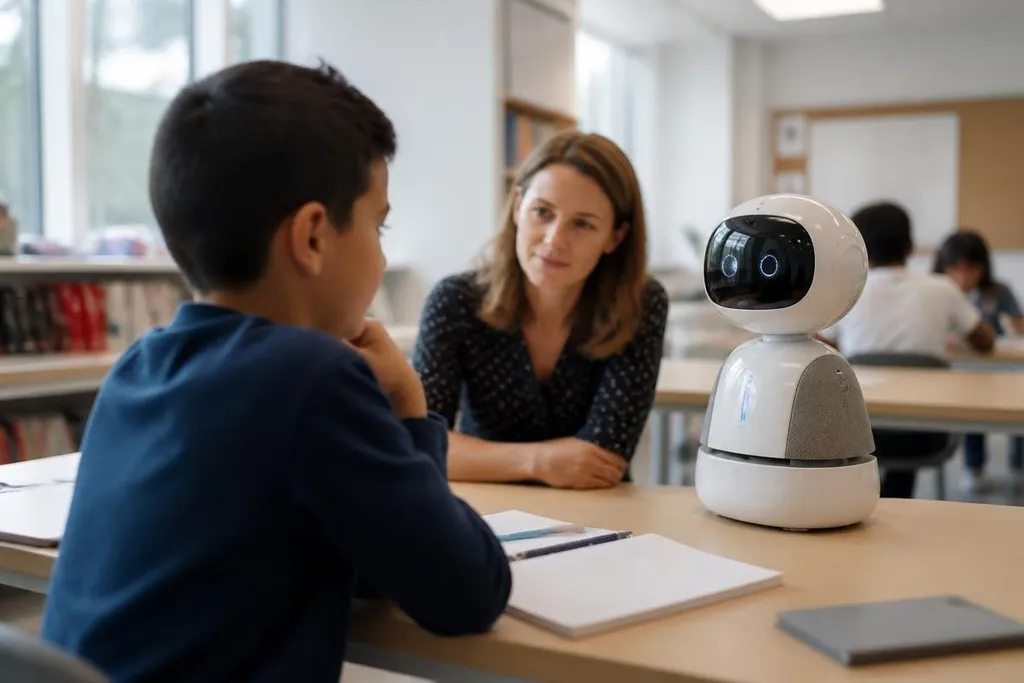
A physical robot adds movement and presence to the lesson. It can point to a card, turn toward a speaker, or place an object on a table during a task. Those actions may help in early education, language practice, or lessons where learners need to handle real objects instead of working only on a screen.
The effect depends on the task. A robot that reads flash cards may be useful for repeated practice. It has a much harder job when a learner must form an argument, manage a group project, or connect a lesson to personal experience.
The data problem
Personalized systems need information about each learner. That can include answers, voice recordings, movement, mistakes, and time spent on a task. Schools need clear limits before a robot enters a classroom, especially when children are involved.
A useful policy should state who can see the records, how long the school keeps them, and whether the maker can use them to train another system. It should also explain how a teacher can correct a wrong record. A robot may read a long pause as uncertainty when the learner was looking away from the screen.
A lesson can’t wait for a router to recover. Dated school robotics reporting at Robot24.com can help you check whether a classroom robot has a manual mode and a clear fault record, rather than treating a demo as proof it can run through a school day.
Privacy is only one concern. A school also needs a fallback when the network fails, a sensor misreads a response, or the robot cannot understand a learner’s accent. The lesson should continue without turning a technical fault into a lost school day.
A teacher remains part of the system
Personalized learning works best when the robot handles repeatable work and the teacher handles judgment. The robot can ask practice questions and record responses. The teacher can decide whether the learner needs a new explanation, a harder task, or help outside the lesson.
That division also keeps the robot’s role clear. A score is a signal, not a diagnosis. A learner who misses five questions may need more practice, but the record alone cannot explain the reason.
I’d keep robots in a supporting role until schools can show that their records are accurate enough for real classroom decisions. The machine can make practice easier to repeat, but the teacher should own the decision about what comes next.
What to check before a school buys one
A school team can use this list before signing a contract:
- Set the learning target. Write down the skill the robot must help teach, such as reading words aloud or solving a type of equation.
- Ask for the failure cases. Find out what happens when speech recognition misses an answer, a learner gives an unusual reply, or the network stops.
- Check the data path. Confirm what the robot stores, where it goes, who can access it, and when it is deleted.
- Keep teacher control. Make sure staff can change tasks, review records, and ignore a robot’s suggestion.
- Test the classroom fit. Check noise, lighting, floor space, charging, cleaning, and repair time before deployment.
The strongest use case will be narrow and easy to measure. A school might begin with reading practice or language drills, then compare completion rates and teacher workload against its existing method. If the robot adds setup work without improving the lesson, the purchase has failed even if the robot moves and speaks well.
Personalized learning will depend less on a robot’s face or voice than on the quality of its feedback, the care around learner data, and the teacher’s control. The practical test is simple: after a term, can staff point to a better learning task, a clear record, and less repeated work?